
Friday, October 4, 2013

Saturday, March 30, 2013
At the Mall

Nothing much has changed at the mall
Since I was young, except…
Now I’m not.
The babes are still there
Dressed to excess and trolling
For guys who gaze on cleavage
The way men who covet cars
Check out the grill:
So whatchu got? Sweet...
Can I have a ride?
And when those pretty little things encounter
Old men’s eyes they smile, as if to say;
You’d kill for a piece of this, wouldn’t you?
How little they know about how little they know!
And when those pretty little things encounter
Old men’s eyes they smile, as if to say;
You’d kill for a piece of this, wouldn’t you?
How little they know about how little they know!
At the mall I saw a dog collar for the price of a pair of shoes.
A pair of
shoes for the price of an outfit.
An outfit
for the price of a car.
And I saw pretty little things in lovely cars purchased
CEH 3.13
Wednesday, March 27, 2013

Thursday, March 21, 2013
Chord Play Method; Ad #1

Chord Play is a meditative approach to picking up acoustic that will have newbies smiling, and old hands falling in love again.

Where's Cannabis?
If films are
meant to portray the truth, where is the truth about cannabis on the big
screen? Not weed; cannabis. Weed is marijuana. It’s typically smoked as a recreational
relaxant. Cannabis is an ancient
medicine, and a conduit for creative and spiritual explorations. While marijuana the chill-out drug is finding
its way to the big screen with increasing frequency, authentic medicinal use of
cannabis doesn’t yet rate a cameo.
Booze, butts and bad behavior
Feature
films and the characters that come to life within them have traditionally
reflected and even informed our popular culture and social practices. This is particularly evident with our use of
drugs. How many smokers light up and
squint like Bogey and Madsen, or sip a stiff one like Pacino and the Bonds? And who hasn’t seen folks, from gay men to
socialites, holding their cigs high-wristed, palm to the ceiling, with the
other hand cupping the elbow. The Bette
Davis pose.
From the indies
to the major studios, drunkenness and hangovers remain standard vehicles for character
tells and scene development. Every December,
millions of viewers still snicker as Uncle Billy, clearly a serious alcoholic,
staggers home while proclaiming to be okay.
The same audience response is expected in Thor (2011) when Dr. Erik Selvig (Stellan Skarsgård ) passes out
from alcohol over-consumption while trying to keep up with the big guy.
Now that we
know the truth and have the stats, tobacco and alcohol use on the big screen
ought to be going down. But it’s not at
all. That’s surprising because filmmaking
is renowned for giving us a view of our culture that is just one step ahead of
the norm. Even as Colorado and Washington
state embody what lies ahead as prohibition fades, visionary films like Avatar (2009) still show us a future with
drug choices and practices that even now are so last-century.
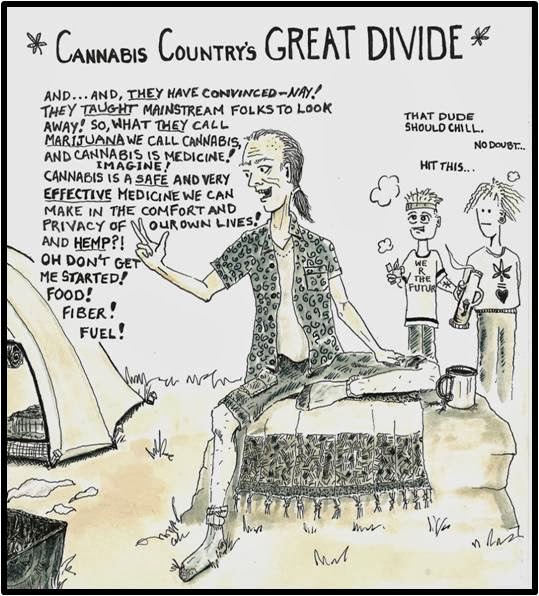
Welcome to Cannabis Country
Cannabis
country is all around us, and the beauty of that (particularly for dramatic storytellers)
is that for the most part that world remains very well hidden and largely
unknown to mainstream Americans. Private
grows are taking off, and many of those home cultivators are making their own
medicine—an act that is strictly forbidden by our government and yet impossible
to stop, tax or control. And within that
shadowy realm, regular folks in ordinary neighborhoods are utilizing cannabis the
exit drug as a substitute for toxic
and addictive substances that wreck the lives of people from all walks of life—and
still define the choices of big-screen characters.
While
cannabis use in upscale neighborhoods is on the rise fast, the best place for
storytellers to find truly dynamic, provocative, knowledgeable, and colorful
characters is to visit with the sort of people found in films like Where the Heart Is (2000) and
Winter’s Bones (2010). Think white, broke down, broken, addicted, violent, uneducated,
and truly sad.
Unless of
course they live in cannabis country, where that same demographic embodies passion,
clarity, exploration, empowerment and enterprise. In rural Maine, you can connect with such
people at the summertime festivals in Starks, where many of them remember the
old days when drunkenness and beating on things was just the way people got
through the long winters. Not
anymore. Local police in that state and
in others have long understood the convenient connection between cannabis use
and a reduction in alcohol-related crime, violence and stupid behavior.
In the
process of learning how to treat themselves (often completely off the grid of
Westernized medicine), rural medicinal pioneers have discovered that cannabis
is a safe and versatile medicine they can grow in the basement and refine in the
kitchen. And since all that
(scene-making) personal exploration can’t kill them, the valuable knowledge
they are acquiring and sharing with trusted friends and family will eventually attract
economic opportunity to regions of this country long assumed to be beyond hope. Not over night, and probably not for decades,
but absolutely. And if it’s in our
future, it ought to be in pictures.
Character, Color and Conflict

There are
two major reasons why filmmakers ought to enrich their stories with medicinal
cannabis themes. For one, cannabis people
and practices represent an untapped goldmine of color, conflict and progressive
social realities. The other reason is
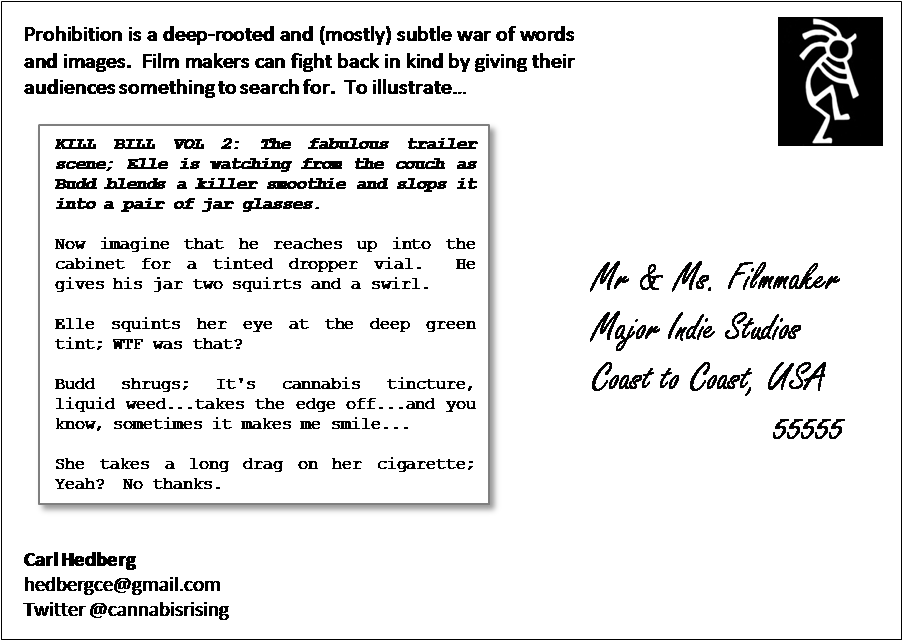
that since prohibition is a deeply installed war of words and images, bringing
the truth to the big screen would be a massive advocacy win for a movement
still defined by its love of binge-bonging festivals.
Movies take
us to places we’d like to be, and to worlds we could never go. If believable big screen characters in excellent
feature films were to use cannabis as medicine in the privacy of their own
lives, mainstream understanding would rise in a Gore minute.
Cannabis prohibition
is on the way out, and since the proof of that future shock can been found in
private homes and lives across America, the truth ought to be evident on the
big screen. It’s not. So while full and unfettered use of cannabis
is sweeping the nation, particularly in states where home cultivation is permitted
(or at least not busted), screen characters are still rolling fatties, filling
bowls and smiling through the smoke.
Cannabis is
medicine; so use it. Lights, camera,
cannabis!
Root essay: Lights, Camera, Cannabis! http://cannabisrising.blogspot.com/2012/07/lights-camera-cannabis.html
Related essay: Cannabis Country sketches for storytellers http://cannabisrising.blogspot.com/2012/11/medicinal-cannabis-use-pot-plots-series.html
Carl Hedberg is a guitar teacher and cannabis freedom writer living in Lafayette, Colorado.
Related essay: Cannabis Country sketches for storytellers http://cannabisrising.blogspot.com/2012/11/medicinal-cannabis-use-pot-plots-series.html
Carl Hedberg is a guitar teacher and cannabis freedom writer living in Lafayette, Colorado.

Wednesday, February 20, 2013

Wednesday, February 13, 2013
A Beautiful Piece
This poem is a perfect description of how tough life can be when you refuse to yield because you know you can't. Adapted from the trailer to the film and the book Kafka on the Shore
by Haruki Murakami.
Biutiful
Sometimes fate is like a small
sandstorm that keeps changing directions.
You change direction, but the
sandstorm chases you.
You turn again, but the storm adjusts.
Over, and over, you play this
out,
Like some ominous dance with
death just before dawn.
This storm isn’t something that
blew in from far away.
It has nothing to do with you.
This storm is you. Something inside you.
So all you can do is give into it;
step right inside the storm.
Make no mistake about it
No matter how metaphysical or
symbolic the storm might be
It will cut through flesh like a
thousand razor blades.
People will bleed there.
You’ll catch that blood on your
hands, your own blood, and the blood of others.
And once the storm is over, you
won’t remember how you managed to survive.
But one thing is certain. When
you come out of the storm, your life won’t be the same,
It will be Biutiful.
Subscribe to:
Posts (Atom)