Friday, July 4, 2014

Listen up newbies: Edibles are not Food!


The war on cannabis is over. It ended earlier this year when the Epilepsy Foundation declared “an end to seizures should not be determined by one’s zip code.” Eventually Obama, or the next one in, will be forced by public opinion to 86 Schedule 1 and reveal our nation's biggest lie. 

Scientists and researchers will then rush in to discover what cannabis patients and others have learned on their own—sometimes the hard way. Cannabis won’t kill you, but it’s not harmless.

Overdoses are on the rise, some have had tragic consequences. The dark side of the cannabis revolution is that the right to choose is returning to a population unaccustomed to using any sort of complex and powerful medicinal herb. Much less one that looks like a chocolate bar and tastes divine…


As Ms. Dowd discovered the hard way http://www.nytimes.com/2014/06/04/opinion/dowd-dont-harsh-our-mellow-dude.html?_r=0. edibles are not food. They’re a multi-dose delivery device for an astonishingly effective non-toxic medicine. Too much of that good thing, however, will serve up a super-nasty ride that won’t kill you but may make you wish it would.


THC overdoses hit hard and go long; fear, confusion, panic, paranoia, anxiety, short-term memory loss, slow reaction time, racing thoughts, dizziness, sweating, hallucinations, nausea, vomiting, severe headache, parched mouth/throat, chills, shortness of breath, low blood pressure, fast heartbeat, heart palpitations, and in some cases ,the sensation of being crushed.


First-timers with edibles and extracts should go slow, and it’s best to start early on a free day. If possible, know what you’re getting. Sativa and indica strains can deliver significantly different strengths and experiences, and activation times can vary tremendously among the many ways cannabis can be consumed.


A conservative trial dose of THC is less than 25 milligrams (mg); keep in mind that a dispensary sweet can easily contain five times that amount. For those with even less tolerance for risk and/or effect, one-tenth of a 100 mg chocolate bar can make for a good trial. If you’re getting edibles at the fair, take heed; potency’s a bragging right in cannabis country.


Green dragon tincture, a fiery reduction extract made with 190 proof spirits, is a Dionysian remedy that can put you down and lay you out. If it’s thick and dark emerald green, test with no more than 8-10 drops (pictured made in Rhode Island from the dank Dutch strain BLZ). 

Tincture evaporates to sticky oil that can produce significant effects from grain-sized doses. On the weaker side is light green menstrum (first press) which may require 25 drops or more to yield a desired effect.


Give it an hour and see how you feel. One of the most common paths to overdose is going double-down—re-dosing before the first dose has kicked in. Wait at least 90 minutes (or longer) between trials. And know what to do if things get rough.


Taking care of yourself in the heavy grip of a THC OD can be a nightmarish experience, especially due to the fear and paranoia that often dominate the early hours. Don’t move about. Get comfortable. Stay away from the stove and don’t light any candles. Drink water and juice. You’ll likely be parched and find it’s hard to swallow so no snacking. Not one chip.


Caring for others who’ve ingested too much weed takes patience and a soft touch. Gently coax the stricken to a quiet, dark sit spot; warm, safe, familiar if possible, with pillows and blankets all around. No bystanders.


A damp cloth on the forehead/over the eyes may settle the nerves and help with the headache and nausea. Stay close but don’t engage in the drama. Be the nurse; relax, close your eyes, breathe, you’re safe here, sleep is on the way…


After a few hours of peak suffering, a physical malaise will settle things down fast. Cannabis is not toxic so there’s no hangover after the deep sleep, and no long term effects, other than maybe wisdom and humility.


WARNING: People with pre-existing conditions such as angina can be at greater risk. Watch for symptoms that warrant professional care including trouble breathing, pale skin color and unresponsiveness. If the individual gets aggressive or crazed, some other drug’s almost certainly in the mix. Make the call.


Bottom line: Cannabis is powerful medicine. Don’t be a dope. Use with respect.


Carl Hedberg is a cannabis care mentor living in Lafayette, Colorado. pvtmeds@hushmail.com


Friday, October 4, 2013

Saturday, March 30, 2013

At the Mall


Nothing much has changed at the mall
Since I was young, except…
Now I’m not.

The babes are still there
Dressed to excess and trolling 
For guys who gaze on cleavage
The way men who covet cars
Check out the grill:

So whatchu got?  Sweet... 
Can I have a ride? 

And when those pretty little things encounter
Old men’s eyes they smile, as if to say;
You’d kill for a piece of this, wouldn’t you? 
How little they know about how little they know!

At the mall I saw a dog collar for the price of a pair of shoes.
A pair of shoes for the price of an outfit.
An outfit for the price of a car.

And I saw pretty little things in lovely cars purchased 
For the price of a comfy home.

CEH 3.13

Thursday, March 21, 2013

Chord Play Method; Ad #1


Chord Play is a meditative approach to picking up acoustic that will have newbies smiling, and old hands falling in love again.


Where's Cannabis?


If films are meant to portray the truth, where is the truth about cannabis on the big screen?  Not weed; cannabis.  Weed is marijuana.  It’s typically smoked as a recreational relaxant.  Cannabis is an ancient medicine, and a conduit for creative and spiritual explorations.  While marijuana the chill-out drug is finding its way to the big screen with increasing frequency, authentic medicinal use of cannabis doesn’t yet rate a cameo.


Booze, butts and bad behavior


Feature films and the characters that come to life within them have traditionally reflected and even informed our popular culture and social practices.  This is particularly evident with our use of drugs.  How many smokers light up and squint like Bogey and Madsen, or sip a stiff one like Pacino and the Bonds?  And who hasn’t seen folks, from gay men to socialites, holding their cigs high-wristed, palm to the ceiling, with the other hand cupping the elbow.  The Bette Davis pose.


From the indies to the major studios, drunkenness and hangovers remain standard vehicles for character tells and scene development.  Every December, millions of viewers still snicker as Uncle Billy, clearly a serious alcoholic, staggers home while proclaiming to be okay.  The same audience response is expected in Thor (2011) when Dr. Erik Selvig (Stellan SkarsgĂ„rd ) passes out from alcohol over-consumption while trying to keep up with the big guy. 


Now that we know the truth and have the stats, tobacco and alcohol use on the big screen ought to be going down.  But it’s not at all.  That’s surprising because filmmaking is renowned for giving us a view of our culture that is just one step ahead of the norm.  Even as Colorado and Washington state embody what lies ahead as prohibition fades, visionary films like Avatar (2009) still show us a future with drug choices and practices that even now are so last-century.


Welcome to Cannabis Country


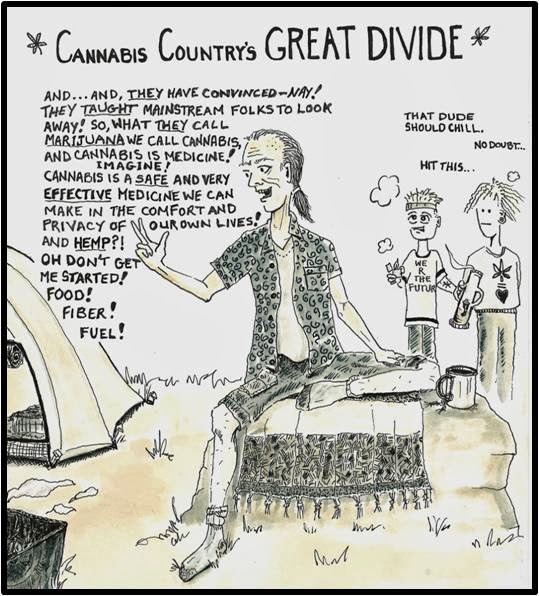
Cannabis country is all around us, and the beauty of that (particularly for dramatic storytellers) is that for the most part that world remains very well hidden and largely unknown to mainstream Americans.  Private grows are taking off, and many of those home cultivators are making their own medicine—an act that is strictly forbidden by our government and yet impossible to stop, tax or control.  And within that shadowy realm, regular folks in ordinary neighborhoods are utilizing cannabis the exit drug as a substitute for toxic and addictive substances that wreck the lives of people from all walks of life—and still define the choices of big-screen characters.


While cannabis use in upscale neighborhoods is on the rise fast, the best place for storytellers to find truly dynamic, provocative, knowledgeable, and colorful characters is to visit with the sort of people found in films like Where the Heart Is (2000) and Winter’s Bones (2010). Think white, broke down, broken, addicted, violent, uneducated, and truly sad.


Unless of course they live in cannabis country, where that same demographic embodies passion, clarity, exploration, empowerment and enterprise.  In rural Maine, you can connect with such people at the summertime festivals in Starks, where many of them remember the old days when drunkenness and beating on things was just the way people got through the long winters.  Not anymore.  Local police in that state and in others have long understood the convenient connection between cannabis use and a reduction in alcohol-related crime, violence and stupid behavior.


In the process of learning how to treat themselves (often completely off the grid of Westernized medicine), rural medicinal pioneers have discovered that cannabis is a safe and versatile medicine they can grow in the basement and refine in the kitchen.  And since all that (scene-making) personal exploration can’t kill them, the valuable knowledge they are acquiring and sharing with trusted friends and family will eventually attract economic opportunity to regions of this country long assumed to be beyond hope.  Not over night, and probably not for decades, but absolutely.  And if it’s in our future, it ought to be in pictures.


Character, Color and Conflict

 
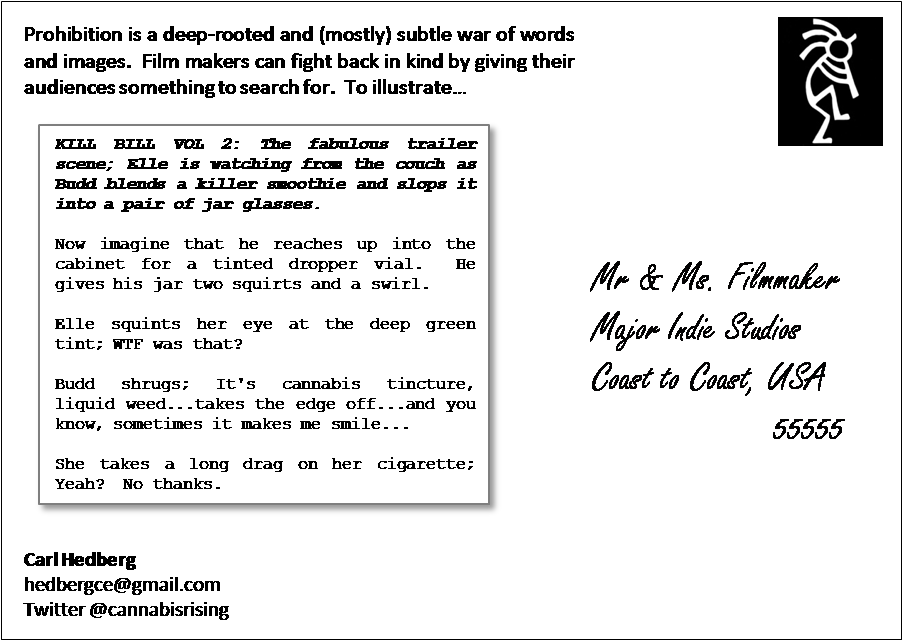
There are two major reasons why filmmakers ought to enrich their stories with medicinal cannabis themes.  For one, cannabis people and practices represent an untapped goldmine of color, conflict and progressive social realities.  The other reason is that since prohibition is a deeply installed war of words and images, bringing the truth to the big screen would be a massive advocacy win for a movement still defined by its love of binge-bonging festivals. 


Movies take us to places we’d like to be, and to worlds we could never go.  If believable big screen characters in excellent feature films were to use cannabis as medicine in the privacy of their own lives, mainstream understanding would rise in a Gore minute.


Cannabis prohibition is on the way out, and since the proof of that future shock can been found in private homes and lives across America, the truth ought to be evident on the big screen.  It’s not.  So while full and unfettered use of cannabis is sweeping the nation, particularly in states where home cultivation is permitted (or at least not busted), screen characters are still rolling fatties, filling bowls and smiling through the smoke. 


Cannabis is medicine; so use it.  Lights, camera, cannabis!


Root essay:  Lights, Camera, Cannabis!  http://cannabisrising.blogspot.com/2012/07/lights-camera-cannabis.html

Related essay:  Cannabis Country sketches for storytellers  http://cannabisrising.blogspot.com/2012/11/medicinal-cannabis-use-pot-plots-series.html

Carl Hedberg is a guitar teacher and cannabis freedom writer living in Lafayette, Colorado.