Showing posts with label marijuana. Show all posts

Friday, August 26, 2016

Perfect Freedom

Since the primary objective of the drug war is to keep the public in the dark about the true nature of cannabis (spoiler alert; it’s medicine) it should come as no surprise that the DEA is still guarding the gates as the walls come down, or that this prohibition era is ending like the last one; by will of the states.

The founders of this country were very clear. We the People have a right to do whatever we want with our own bodies. No provisos, no quid pro quos. Our bodies, our lives, our choices. And we earn that perfect freedom by taking personal responsibility for our actions in all aspects of our lives. 

It will take a few more freed states to shame Washington into ending its longest war, but to be sure, drug choice enforcers with their bullshit schedules and prisons enough for us all are finished in America. Prohibition has no place in a free country.

Wednesday, February 25, 2015

Toon: The Circus on the Way to a Place Called FREEDOM

This panel was inspired by the work of misguided religious leaders, oh-so last-century moralists and prohibitionists, greedy industrialists and lying politicians.

The best example of the CRAZY in the waning years of cannabis prohibition is that while the US Surgeon General recently admitted that cannabis is medicine, the flower still remains listed as a Schedule 1 substance.

Richer still is the fact that Washington uses every agency it has to disrupt and hold back the rise of the cannabis trades, and yet, since 2003, the US has held a patent on the medicinal effectiveness of cannabinoids! US Patent # 6630507 was filed by Health & Human Services, the same agency that is still saying non-toxic cannabis is so dangerous even research ought to be carefully managed.

On the advocacy side of the circus the legalization forces have focused on the casual smoked aspects of cannabis, which is exactly what prohibition propaganda has been 'pushing' for nearly 80 years. Prior to the big drive to demonize this natural healing flower, cannabis was well known as medicine in the form of tincture. Laudanum, an opium tincture, was in all drug stores as well, but unlike cannabis tincture, was extremely addictive and potentially fatal. With the invention of pills and injectables both medicines fell from popular use because the 'modern' stuff was so easy to use.


Friday, October 24, 2014

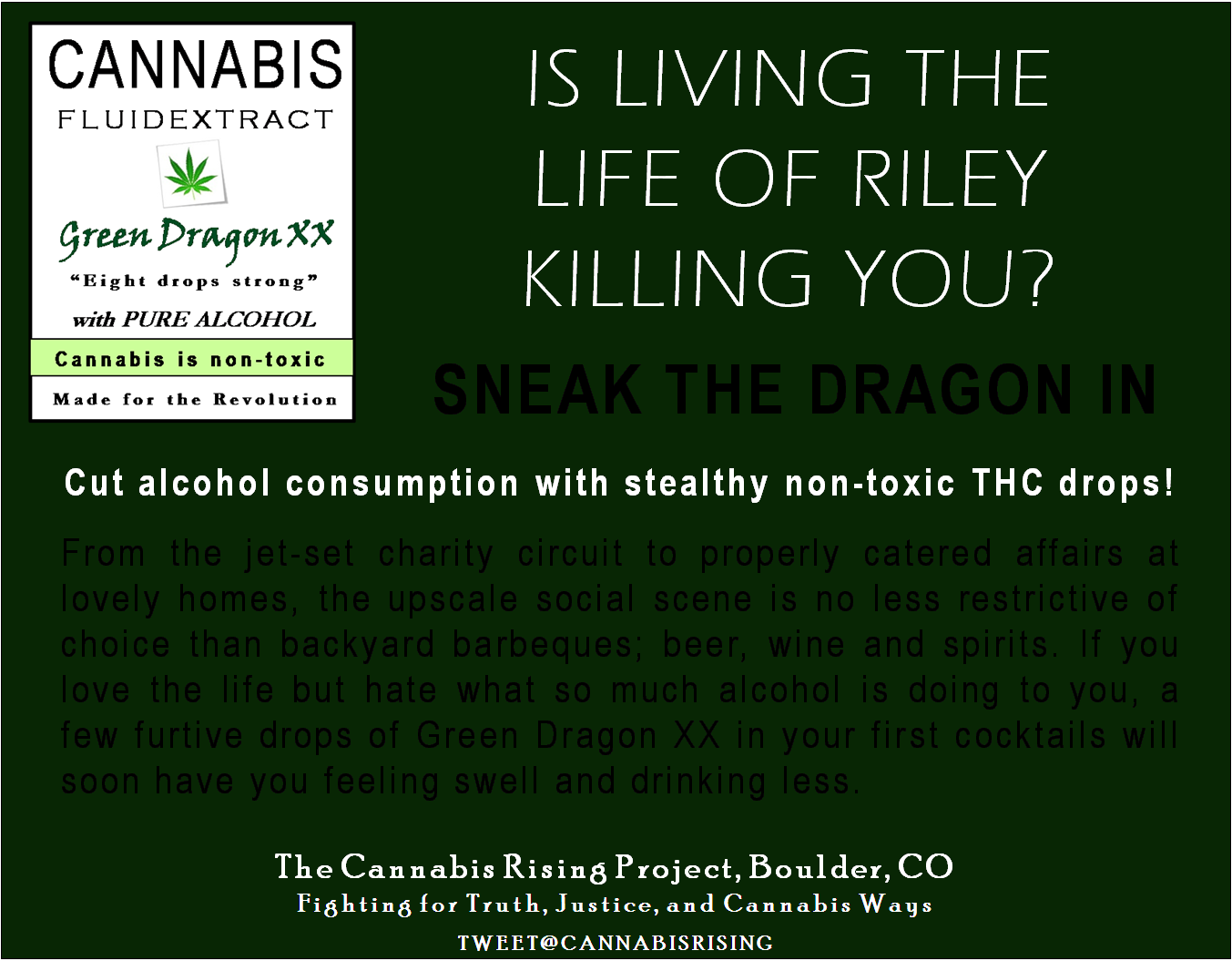
Reducing over-consumption of alcohol with potent cannabis tincture. Great for hangovers, too!

Potent green dragon tincture is an astonishingly effective medicine for a wide range of maladies, including migraines, anxiety, chronic pain, PMS and sleep disorders. A bigger story is about to break.


HEADLINE NEWS:  Dragon Drops Help Drinkers Drink Less


Green dragon XX cannabis tincture, a REVOLUTIONARY OLD MEDICINE is proving to be a lifesaver for people suffering from the effects of too much drink, including friends and family members who must endure the disease right along with the sufferer.

'Sensible' approach SAM president Kevin Sabet worries that adding cannabis to the mix in low income areas of DC will add to the problems they already have with alcohol. Here he is debating on CNN. https://www.youtube.com/watch?v=sjfFnY_J2S0&feature=youtu.be


QUESTION: What if the truth was precisely the opposite; what if super-potent cannabis tincture could actually help alcohol abusers back away from behavior that's ruining and ending their lives?


ANSWER: The war would be over and you, Mr. Sabet would be looking for a new mission.


TRUE STORY FROM THE FRONT LINES
Late one afternoon, a young man celebrating his 21st drops by a grow house in Rhode Island with a fifth of rum.  An infamous trouble maker and aggressive drunk, he’s well underway with a loud promise to polish off the bottle by midnight.
He’s there to buy weed from one of several black-market growers who’ve gathered to sample the latest batch from the tincture guy. They supply him with trim and grain alcohol, and he brews up some potent cannabis extracts, minus his fee in vials. He listens and learns from his lab bench while they dose and talk cannabis .
The arrival of the loud dude interrupts a chat about using edibles and extracts for ADHD instead of ‘modern’ meds. The old medicine maker sets down his glasses and swivels away from his well-lit filling station holding up a tiny amber dram vial.
“For your birthday, my friend! Two hundred drops of liquid weed, made with pure alcohol. Green dragon double X; eight drops strong.”
He aims the vial at the bottle; “To party with the dragon, just dose that with this.”
The big guy loves the idea, and from then on, every shot gets drops. Ninety minutes later the rabble rouser is still there and smiling up from the couch.
 “Wow…whoa…I had no idea…this shit is real medicine, huh?”

He drank a lot less that night, had just as much fun, and woke up feeling fine.


Sunday, September 7, 2014

Top Ten Cannabis Truth Searches

  1. Run from the Cure
  2. Sir William Osler
  3. Lester Grinspoon
  4. Cheryl Shuman
  5. Shona Banda
  6. Mykayla
  7. Cash Hyde
  8. David Triplett
  9. Charlotte’s Web
  10. US Govt patent # 6,630,507


Thursday, July 17, 2014

Tincture Testimonial

A Prohibition state woman contacts a tincture maker in Colorado. Mom has a rare form of cancer. She's not doing well with the chemo, and the disease isn't going anywhere. He makes her a batch of potent green dragon tincture; 8 drops strong. She meets him at the border, gets it to her mom. The mom is skeptical about the pot 'medicine' but agrees to take a full dose four times a day. Weeks go by and then...

"I wanted to give you an update on my mom. She continues with chemo and had scan results about a week and a half ago.  The dr. told her that treatment is working so they will continue to treat. She continues to take her medicine 4 times a day. 

She has been gradually increasing her dose with a large dose at night. She is sleeping well, still off all pain meds and is feeling well. She cleaned her room today and went shopping. She has maintained her weight since starting the medication. 

She went to the dr today and they couldn't believe how great she looked. A nurse she is close to asked her what she was doing? She told her she was taking the "stuff". The nurse gave her a high five! Mom is very pleased with how things are going.  She continues to be very committed to taking her medicine..."


Nuff said. 

Prohibition era tincture boil. Rhode Island. 2011

 Related story, a heartbreaker

Thursday, March 21, 2013

Where's Cannabis?


If films are meant to portray the truth, where is the truth about cannabis on the big screen?  Not weed; cannabis.  Weed is marijuana.  It’s typically smoked as a recreational relaxant.  Cannabis is an ancient medicine, and a conduit for creative and spiritual explorations.  While marijuana the chill-out drug is finding its way to the big screen with increasing frequency, authentic medicinal use of cannabis doesn’t yet rate a cameo.


Booze, butts and bad behavior


Feature films and the characters that come to life within them have traditionally reflected and even informed our popular culture and social practices.  This is particularly evident with our use of drugs.  How many smokers light up and squint like Bogey and Madsen, or sip a stiff one like Pacino and the Bonds?  And who hasn’t seen folks, from gay men to socialites, holding their cigs high-wristed, palm to the ceiling, with the other hand cupping the elbow.  The Bette Davis pose.


From the indies to the major studios, drunkenness and hangovers remain standard vehicles for character tells and scene development.  Every December, millions of viewers still snicker as Uncle Billy, clearly a serious alcoholic, staggers home while proclaiming to be okay.  The same audience response is expected in Thor (2011) when Dr. Erik Selvig (Stellan SkarsgÃ¥rd ) passes out from alcohol over-consumption while trying to keep up with the big guy. 


Now that we know the truth and have the stats, tobacco and alcohol use on the big screen ought to be going down.  But it’s not at all.  That’s surprising because filmmaking is renowned for giving us a view of our culture that is just one step ahead of the norm.  Even as Colorado and Washington state embody what lies ahead as prohibition fades, visionary films like Avatar (2009) still show us a future with drug choices and practices that even now are so last-century.


Welcome to Cannabis Country


Cannabis country is all around us, and the beauty of that (particularly for dramatic storytellers) is that for the most part that world remains very well hidden and largely unknown to mainstream Americans.  Private grows are taking off, and many of those home cultivators are making their own medicine—an act that is strictly forbidden by our government and yet impossible to stop, tax or control.  And within that shadowy realm, regular folks in ordinary neighborhoods are utilizing cannabis the exit drug as a substitute for toxic and addictive substances that wreck the lives of people from all walks of life—and still define the choices of big-screen characters.


While cannabis use in upscale neighborhoods is on the rise fast, the best place for storytellers to find truly dynamic, provocative, knowledgeable, and colorful characters is to visit with the sort of people found in films like Where the Heart Is (2000) and Winter’s Bones (2010). Think white, broke down, broken, addicted, violent, uneducated, and truly sad.


Unless of course they live in cannabis country, where that same demographic embodies passion, clarity, exploration, empowerment and enterprise.  In rural Maine, you can connect with such people at the summertime festivals in Starks, where many of them remember the old days when drunkenness and beating on things was just the way people got through the long winters.  Not anymore.  Local police in that state and in others have long understood the convenient connection between cannabis use and a reduction in alcohol-related crime, violence and stupid behavior.


In the process of learning how to treat themselves (often completely off the grid of Westernized medicine), rural medicinal pioneers have discovered that cannabis is a safe and versatile medicine they can grow in the basement and refine in the kitchen.  And since all that (scene-making) personal exploration can’t kill them, the valuable knowledge they are acquiring and sharing with trusted friends and family will eventually attract economic opportunity to regions of this country long assumed to be beyond hope.  Not over night, and probably not for decades, but absolutely.  And if it’s in our future, it ought to be in pictures.


Character, Color and Conflict

 
There are two major reasons why filmmakers ought to enrich their stories with medicinal cannabis themes.  For one, cannabis people and practices represent an untapped goldmine of color, conflict and progressive social realities.  The other reason is that since prohibition is a deeply installed war of words and images, bringing the truth to the big screen would be a massive advocacy win for a movement still defined by its love of binge-bonging festivals. 


Movies take us to places we’d like to be, and to worlds we could never go.  If believable big screen characters in excellent feature films were to use cannabis as medicine in the privacy of their own lives, mainstream understanding would rise in a Gore minute.


Cannabis prohibition is on the way out, and since the proof of that future shock can been found in private homes and lives across America, the truth ought to be evident on the big screen.  It’s not.  So while full and unfettered use of cannabis is sweeping the nation, particularly in states where home cultivation is permitted (or at least not busted), screen characters are still rolling fatties, filling bowls and smiling through the smoke. 


Cannabis is medicine; so use it.  Lights, camera, cannabis!


Root essay:  Lights, Camera, Cannabis!  http://cannabisrising.blogspot.com/2012/07/lights-camera-cannabis.html

Related essay:  Cannabis Country sketches for storytellers  http://cannabisrising.blogspot.com/2012/11/medicinal-cannabis-use-pot-plots-series.html

Carl Hedberg is a guitar teacher and cannabis freedom writer living in Lafayette, Colorado.


Friday, November 2, 2012

Cannabis country sketches for screenwriters


Compelling, true life cannabis conflict is happening in the shadows all around, but it’s almost never portrayed on film.  Here are some sketches of characters struggling in the conflict zone, on the hard road between now and the restoration of a patient's right to choose and responsibly use cannabis.  

Clean not sober
A creative, thoughtful, introverted atheist from a conservative Philadelphia family is slowly dying from alcohol and drug abuse.  Now in her late 30s, Darci has been in and out of Western-style rehab eight times in a dozen years.  She hates everything about it; the group meetings, the halfway houses, the religious overtones, and the pill prescriptions for depression that dampen her creative skills.  She has tried cannabis in the past to no ill effect, but her well-respected psychologist insists that weed is what got Darci into this mess, and that’s good enough for her family.  So instead of questioning the methodology, the science, or the practitioner (who believes cannabis is just pot), they blame the patient for failing to get with the program.[1]  At a family gathering her favorite nephew quietly reveals he has taken himself off his OCD and depression meds with cannabis tincture. He offers to help.

Cannabis for Kids
Taylor is sixteen and has been on medication for ADHD since he was nine.  He’s a smart kid but a terrible student. He’s dazed, uninspired, and at times quietly suicidal.  He has never thought much about the medicine being prescribed to him by his doctor and given to him by his caring, single mom.  In Oklahoma that’s what is prescribed for what he has.  Boulder, Colorado, he discovers, is a long way from Tuttle, Oklahoma.  During a visit with his 'black sheep' father (a bud tender with a Colorado cannabis dispensary) he learns there is an alternative to prescribed medicines. Back home, his mom forbids him from even discussing the possibility of substituting cannabis for his 'modern' meds.  Taylor decides to explore on his own with goodies his father drives to the border.  His first attempt at treating himself goes badly.  He ends up in the hospital with an edibles overdose. He is arrested and the charges will ruin his life, unless he reveals the source.

Fighter for freedom not free to choose cannabis
A soldier returns from Afghanistan and tries to settle back into normal life in Southern New Hampshire.  Casey is physically fine but is tormented by the action she saw, and by the actions she took to survive.  Her brother Dave is a successful lawyer and closet weed aficionado whose wife and family believes he tokes far less than he does.  Lately Dave has been exploring green dragon tincture[2] as a stealthy means of enjoying a good buzz without drinking so much at cocktail parties.  He encourages his sister to try it as a sleep aid and to calm her daily anxiety.  Casey resists at first because she has a good civilian job with a local defense contractor that has a zero tolerance for use of illegal substances.  They’ve never drug tested, so after another bad week of nightmares, Casey gives tincture a try.  It works for her, and when an old Yankee farmer at a coffee shop in Peterborough spies Casey furtively dosing her oatmeal with cannabis drops, she quietly introduces herself.  Suddenly Casey is learning how to make extracts and edibles from an expert grower who has been quietly growing her own for years.  Casey brings a couple of small, potent cookies to work, planning to bite off tiny pieces throughout the day.  When she leaves her desk, a bothersome, unsuspecting co-worker swipes one of the treats and has a bad overdose.  Casey is immediately fired.  The local police are taking it seriously as well, and if convicted, Casey could lose not only her military benefits, but her freedom.

Important!  No rights reserved. No restrictions apply.  e-signed: Carl E. Hedberg

Related articles: 


[1] Related article: Baking with Mom  http://cannabisrising.blogspot.com/2012/09/baking-with-mom.html

Saturday, July 28, 2012

Cannabis Tincture/Oil Recipe

This piece is in memory of Cash Hyde, a little boy from Montana who made news because he responded well to cannabis tincture and oil, but later died from his brain cancer when Montana closed the dispensaries. Throughout the ordeal his family was relentlessly hounded and threatened by our government. 


WAKE UP AMERICA!! Cannabis is ancient medicine that is proving effective against a wide range of ailments, including cancer. Currently available only through the cannabis underground, so here's how to make this marvelous medicine in the privacy of your own lives.


Tincture/oil making instructions for home growers


Ingredients:  1 pound dried flower room trim and about 3-4 liters of grain alcohol

Step 1:  Dry.  Spread out and dry quickly to avoid mold.  The quality of the extract, including flavor and effect, relates to the amount of top-bud in the mix.  However, lower-tier inputs (just trim, vaporized shake, shake, etc) are just fine and can be adjusted for.  

Step 2: Bake.  Spread one layer at a time on sheet pans. 'Decarboxilate' at 240 degrees for 25 minutes.

Step 3a: SAFE & LOW METHOD: Soak the decarbed green material in grain alcohol for 10-14 days; agitate daily.

Step 3b: FAST AND SOMEWHAT DANGEROUS METHOD: Boil. Mix the trim with grain alcohol until well-soaked and sitting slightly under the liquid line.  Absorbtion rates vary so it may take more or less alcohol.  Bring to a boil and simmer for 25 minutes in a pot that either reconstitutes the alcohol (a still) or is rigged to prevent too much boil off during this first step.  DANGER!!!  THE DENSE HOT VAPOR IS EXTREMELY FLAMMABLE AND CAN BUILD UP IN CLOSED AREAS WITH EXPLOSIVE CONSEQUENCES.  USE A FAN TO DISPERSE FUMES AND DON’T SMOKE ANYTHING NEARBY.
Step 4: Strain through cheesecloth.  To prevent a potentially unpleasant overdose, wear gloves. This straight medicinal extract is called menstrum.  For most patients this lighter strength tincture requires too many drops (too much alcohol) to work for them as a medicine.

Step 5: Reduce.  Using a smaller French press seated in a pot of simmering water, bring the base to a vigorous bowl. For green dragon tincture with a dosage range of 3 to 10 drops, reduce the menstrum to 6-10 fluid ounces.  For lower-tier inputs (just trim no flowers) reduce to 3 to 5 fluid ounces. See fire caution above!

Step 6: Titrate (test)  A critical step is to determine your personal potency.  Try 2-4 drops and see how you feel in an hour. If the effect is light or not at all, wait an hour and test 5-7 drops. Repeat until you've determined your dose. No need to rush. If ten drops does nothing for you, reduce further (see step 5). Invite patients and others to test the results as well but keep in mind the effect is unique for everyone; 3 drops can feel plenty strong for a big guy while his girlfriend may feel nothing from 8 or more.

Step 7: Bottle. Tincture must be warmed up for pouring into dropper bottles. Again the French presses with metal footings are great for this since they have sharp pouring spouts.

Note to sellers and gifters: This medicine is unknown to many so use informative wraps and packaging that can show and tell the truth.  Prohibition propaganda is a war of words and images.  Fight back in kind.
FOR PASTE:  Fill a small glass votive candle holder with 4X reduction tincture (yield from 1# dry inputs ~4 oz).  Set aside or gently heat to evaporate all the remaining alcohol.  Use a wood stirrer from Starbucks to dip out a rice grain size dose.


Bandit boil in the shadows of the Great Prohibition. Rhode Island, 2010


Oh, I nearly forgot the Disclaimer: This material is presented for entertainment purposes only.  The medicinal flower that must not be named is illegal in most areas and deemed not fit for human consumption.  Our government tells us what we are permitted to use for medicine and we ought to follow those rules since they have our best interests in mind.

Friday, June 22, 2012

Seshat's Secret


Solving the mystery of what the ancient Egyptian goddess of wisdom was all about brings to light the true nature of the world’s favorite forbidden flower

I am not an Egyptologist, but I played one as a boy in the late 60s.  Attracted by the art, the mythology and the unsolved mysteries, I spent enough time in the Egyptian collection at the Museum of Fine Arts in Boston to recognize when objects were moved around or rotated off the floor.  One unsolved mystery is the meaning of the emblem symbolizing Seshat, the sexy and mysterious goddess of wisdom, writing and measurement.
I never paid the question much mind as a kid, but recently I stumbled on an image of a Seshat carving sporting what looked like a 5-point cannabis sun leaf; Northern Lights to be exact.  My work with legal cannabis patients and care growers in New England gives me access to such leaves, so I scanned a few and chose point counts to correspond with Seshat emblem silhouettes I made from online photos (see below). 
The notion that Seshat is the patron goddess of cannabis is not so far-fetched.  Her symbol is among the oldest hieroglyphs, and although cannabis is not native to North Africa, it would have grown well there—and been available through trade routes.  Indications for use of cannabis and instructions for preparation are in some of the oldest medical texts in existence.[i]

Temple walls depict festive royal spirituals featuring beer, wine, psychoactive concoctions[ii], ceremonial sacrifices, and exotic dancers including the Seshat priestess herself—turning heads in a dazzling leopard-skin number favored by funerary priests.  Lotus buds soaked in wine produced a spiritual effect of such importance that much of their art and architecture was devoted to the flower.

No temples to Seshat have ever been found, and the psychoactive use of cannabis in ancient Egypt is thought to be less well documented—or maybe the truth is all over the walls and we just can’t see it through the haze of drug war propaganda. 

Prohibition did not start with the banning of cannabis in the 1930s.  It began many centuries earlier with religious edicts that forbid—on pain of death—the use of psychoactive plants as spiritual sacraments.  The industrial revolution went even further by creating a propaganda campaign that turned the world against natural medicines, and by outlawing plants that could deliver euphoric and/or spiritual sensations. 

That’s where Seshat comes in.  We know the ancient Egyptians were intelligent, spiritual, and as a culture, very successful (For the United States to be half as long-lived, our Constitution would have had to date back to the mid-700s AD).  If cannabis was revered in those ancient times the way it is today (mostly in the shadows by people you’d never think…) that’s one more body slam against the crumbling walls of prohibition.

Establishing the Proof

Here are six Seshat emblems from their golden age; The New Kingdom (c.1550-c.1069)[1]

Artistic interpretations and dynastic variations are an excellent measure for eliminating popular guesses.  For example, if the top piece looks like a bow at Luxor and like horns at Karnak, it probably isn't representating either one; the explanation must work across all variations. (Condition 1) 

Since the two parts of the emblem never appear separately, the explanation must describe how the images work together to symbolize one concept. (Condition 2)

Seshat was the deification of wisdom; the goddess of writing, astronomy, architecture, and mathematics.  She was an exotic dancer with spirit-realm connections.  In the Coffin Texts, a collection of funerary spells written beginning in the First Intermediate Period (c.2181-c.2055), spell 10 states:  Seshat opens the door of heaven for you. [iii] The explanation for the symbol must reflect the whole of Seshat’s complex character. (Condition 3)

The human embodiment of the goddess was a royal priestess—a smart, creative and powerful top advisor to the king; the keeper of records and chief architect responsible for laying down measurements for royal projects.  The explanation must plausibly reflect the life and duties of an actual Seshat priestess. (Condition 4)  

First Inquiry:  What is that star-shaped thing?

It’s not a star because the base of the emblem is often not star-shaped at all.  Same for palm leaves.  As for papyrus, that is the least likely candidate since the hieroglyph for that sacred plant is everywhere and it looks nothing like the Seshat symbol. 

Cannabis hemp leaves have been called a match, but that food and fiber cultivar cannot begin to capture the full color spectrum of this goddess and her earth-bound representative.

Cannabis leaves vary greatly between strains, but point counts of 5, 7 and 9 are common.  Here are three representatives collected at legal grows in New England.[3]

Although the emblem renderings above differ widely in shape and artistic style, cannabis is a perfect match for every image in the set.  This satisfies the first condition of the proof.

Second inquiry:  How does the cannabis leaf work with the image above?

Unlike the leaf, the upper shape is portrayed in a variety of ways.  In the hieroglyph and in the emblem from the Red Chapel of Queen Hatshepsut (B) the top piece appears to be flowing down and around the leaf.  When the top is closed, either with a point (A & F) or a cap (C), the image still seems to be coming down from above, like a falling veil. 

Given that the message must be evident in all cases, this wide range of interpretations suggests that the image on top is symbolic rather than physical.  It also suggests that the answer lies in what the designs have in common.

In every carving the upper shape flows down from above and around an image that always looks like a cannabis leaf.  That leaf always rises straight from the crown of Seshat’s head, and always stands at attention under the veil.

The leaf is cannabis, and the veil is the wisdom it bestows.  Taken together the two images represent the source of Seshat’s creative ideas, cosmic intuition and spiritual connection.  This satisfies the second condition.

Third inquiry: Does this explanation reflect the whole of the Seshat mythology?

This might be a hard pill to swallow for nations of people raised to just say no, but nothing about this smart, colorful and spirited multi-tasker is inconsistent with cannabis use. 

This ancient truth is reflected in the lives of creative thinkers and people of action like Steve Jobs, John Lennon, and in the words of the late astronomer, mathematician, philosopher and novelist Carl Sagan.  Writing anonymously as Mr. X in the groundbreaking 1969 book Marijuana Reconsidered, Sagan described cannabis as a spiritual conduit for ideas and creative expression:

"I do not consider myself a religious person in the usual sense, but there is a religious aspect to some highs. The heightened sensitivity in all areas gives me a feeling of communion with my surroundings, both animate and inanimate…Many but not all my cannabis trips have somewhere in them a symbolism significant to me…a kind of mandala embossed on the high. Free-associating to this mandala, both visually and as plays on words, has produced a very rich array of insights.”[iv]

People who use cannabis to spark insights and creativity (artists, professionals, clergy, teachers…mostly all in hiding) would agree that the whole of Seshat—the writer, the spiritualist, the dirty dancer, as well as the no-nonsense nail-the-numbers professional getting baked on the job—are all well within the lifestyles and possibilities of people who use cannabis.  This satisfies the third condition.

Final inquiry: Does this explanation relate to real life in ancient Egypt?

Yes.  Cannabis was known as medicine and would have been available to people with resources and trade connections.  The famously fertile delta would have supported local cultivation, and the variety of point configurations in the drawings supports the notion of favored strains.  The notion of a private palace home grow is also consistent with the mythology; Seshat was known as a secretive goddess who preferred the company of royals.[v]  This satisfies the final condition.

Why this matters

This is more than an academic exercise.  Cannabis prohibition is a war of words and images, and until quite recently our government was in total control.  History will record the irony; the very communication system that was being used to broadcast lies about this so-called recreational drug was suddenly the means by which the people could learn and share the truth about what cannabis really is.

As we head into this new century, few things represent the future better than cannabis, an ancient plant that can deliver food, fiber, fuel, medicine, inspiration, and an occasional laugh.  Seshat reminds us that sometimes the best way forward is to look back and learn from the wise ones who came before.

Carl Hedberg is a writer, speaker and medicinal use explorer working with filmmakers to bring the truth about cannabis to the big screen. (see http://www.dailycamera.com/guest-opinions/ci_25298250/lights-camera-cannabis )

From the lecture; Cannabis Rising: Truth and healing on the front lines of the battle to restore our right to choose.  Twitter @cannabisrising 


[1] A. Temple complex at Karnak/18th dynasty,  B. Red Chapel of Queen Hatshepsut (1473-1458)/18th dynasty,  C. Luxor Temple; Ramesses II (1279-1213)/18th dynasty,  D. Medinet Habu mortuary of Ramesses III (1184-1153)/18th dynasty,  E. Temple complex at Karnak/18th dynasty,  F. Temple of Osiris, Abydos; King Seti I (1294-1279)/19th dynasty

[2] Comparison images (l-r):  Seshat emblem and papyrus hieroglyphs, 2 palm leaves, papyrus stem
[3] Cannabis sun leaves (l-r): Northern Lights (5 points), OG Kush (7), Jack Herer (9).  Not in relative scale to each other.


[i] http://cannabination.com/2011/02/05/anceint-egypt-and-cannabis/
[ii] http://www.entheology.org/edoto/anmviewer.asp?a=65
[iii] http://en.wikipedia.org/wiki/Seshat
[iv] http://marijuana-uses.com/mr-x/
[v] http://en.wikipedia.org/wiki/Seshat's_emblem (Note that the word "sesheta" means hidden things, mysteries, secrets, and through Seshat the Pharaoh was given access to the power of those mysteries).